NB: This paper was written for the British Association of Modern Studies’ (BAMS) conference, ‘Modernism Now!’, held at the Institute of English Studies, University of London, in June 2014. I have done my best to preserve the context of that presentation with the PowerPoint images and links included here. The text is otherwise unchanged, aside from the title, which was originally: ‘“Once more in the city I cannot name”: John Beer’s The Waste Land and the Possibility of Metamodernism’.

Introduction
In May 2014, news outlets showed unusual restraint in their reluctance to air the video Elliot Rodger uploaded before killing six people and himself at the University of California, Santa Barbara. YouTube (temporarily) removed it the day after the shootings, though not before a transcript appeared on the LA Times website. Roughly 17 hours later, on the morning of Sunday, May 25th, the Huffington Post published ‘The Last Words of Mass Murderer Elliot Rodger Remixed Into Poetry’ by Seth Abramson, a US poet with a regular column on the site. It included this explanation:
The aim of this metamodern poem is to turn on their heads those words of hatred Elliot Rodger left behind him as he exited this world. A remix of the words Rodger used in his final YouTube video, the poem uses each and every word Rodger spoke in that hateful oration—and no more (25 May 2014, 2:34 AM California time).
The poem itself isn’t especially interesting. The first section adopts a perspective and tone very similar to Rodger’s, with choppier syntax and repetitions only slightly exaggerating the sense of divine injustice the speaker feels he has suffered. Shorter second and third sections at least turn Rodger’s words against this figure, offering an increasingly god-like condemnation:
All have wanted affection. All have wanted adoration. All have. You have.
But you can never be forgiven now.
To the last day of humanity, you will never have kissed a girl. To the last day, you will be a virgin. You will rot for years on years. Rot in an old truth: that time will give you exactly what you deserve.
(Seth Abramson, 2014)
It ends more abstractly, breaking Rodger’s language down to its illogical components, and severing any possibility of understanding between that accusative ‘you’ and his solipsistic ‘I’:
All things stop at “I.”
“I have my will.”
I.
“I showed my will. I treated you to it. I have been it. I am it.”
I. I.
“I am that which I have been. I am all of it. All of that. All the while. Every while. I am I, and of I.”
Of. Of. Of.
Of Of.
Of.
(Abramson, 2014)
Whether or not the poem deserves the most cursory analysis, its posting generated plenty of comment. Twitter’s swift wrath against was hardly appeased when he referred to himself with the ill-advised hashtag #firstresponderpoet:
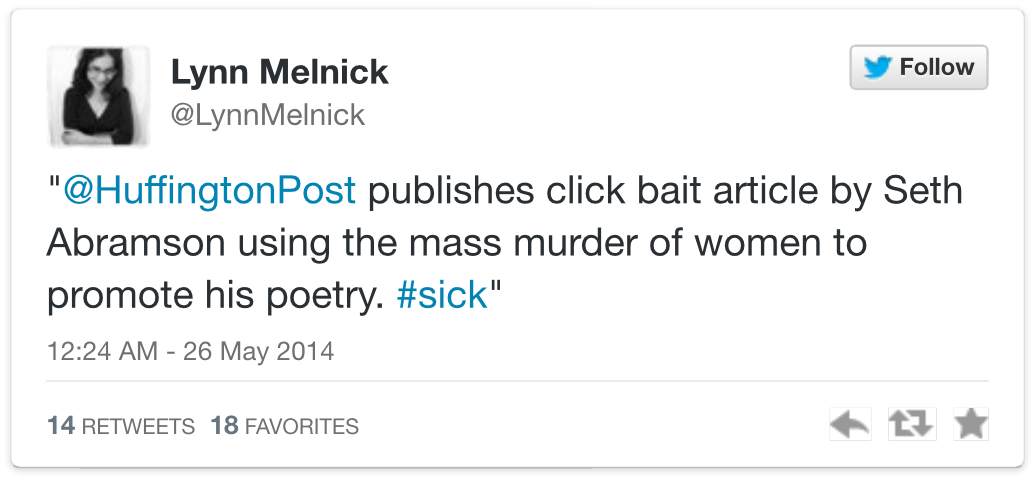
Adam Weinstein, a writer for Gawker, also chimed in:
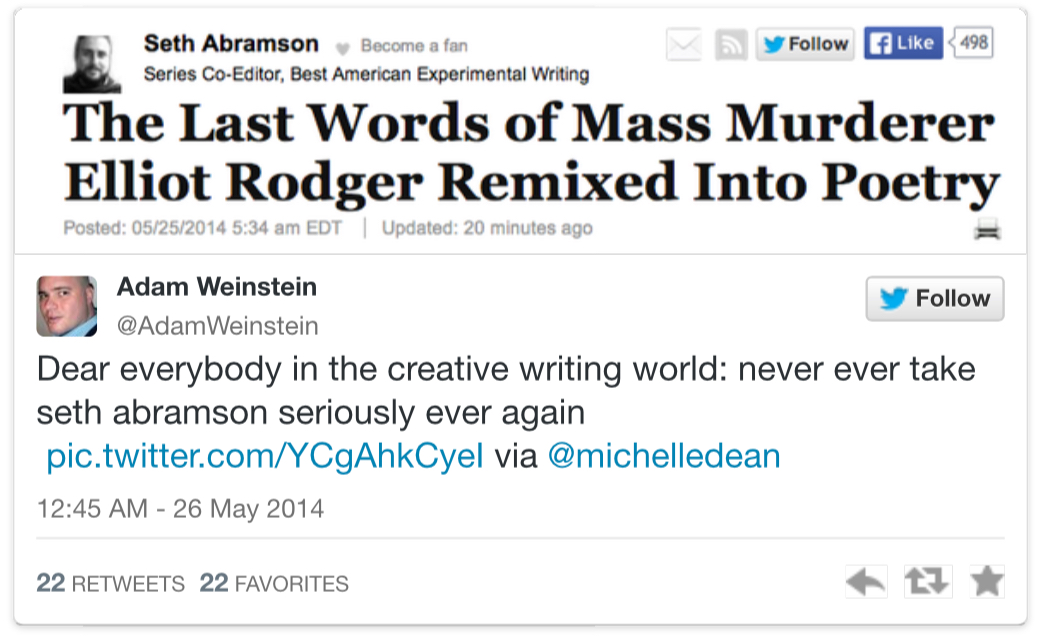
(Abramson has since deleted almost his entire Twitter feed, including various apologies.)
Amid the much more widespread #NotAllWomen hashtag which trended after the killings, other poets joined the public shaming: ‘Where were you when Seth Abramson struck where tragedy struck?’ one tweet asked. And in the ultimate humiliation this age can offer, there was even a short-lived parody account for ‘First Responder Poet’, which advised:
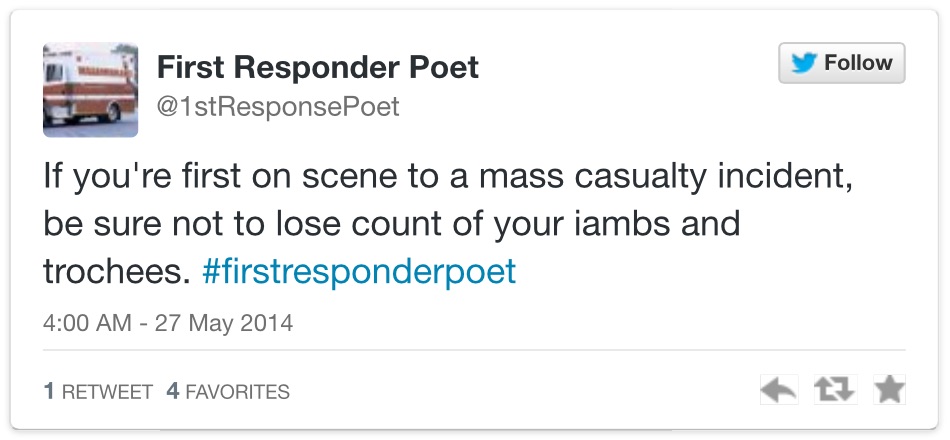
Metamodernism
At the risk of ambulance-chasing Abramson’s offenses now, I suppose I should say what this all has to do with modernism. In the introduction to his ‘remix’, Abramson referred to it as a ‘metamodern’ poem. I don’t want to assume anyone’s familiarity with the recent rise of this term – metamodernism – so a potted history might be in order. In 2010, two Dutch cultural theorists, Timotheus Vermeulen and Robin van den Akker, who were then working towards PhDs at the University of Reading and the Erasmus University Rotterdam, published the article ‘Notes on Metamodernism’ in the Journal of Aesthetics and Culture. It begins by citing Linda Hutcheon’s observation that ‘the postmodern moment has passed’:
Post-postmodernism needs a new label of its own, and I conclude, therefore, with this challenge to readers to find it—and name it for twenty-first century (The Politics of Postmodermisn, 2nd ed., Routledge, 2002, p. 181).
After dismissing Gilles Lopvetsky’s ‘hypermodernism’, Alan Kirby’s ‘digimodernism’, Robert Samuels’ ‘automodernism’, and Nicholas Bourriaud’s ‘altermodernism’, Vermuelen and Van den Akker offer ‘metamodernism’. The prefix ‘meta-’, in this case, emphasises a ‘between-ness’ or ‘oscillation’ which defines this emergent ‘structure of feeling’ or new phase of artistic, political, and cognitive development. More specifically: ‘Metamodernism oscillates between the modern and the postmodern’ (p. 5). As a self-centred modernist scholar – and in the interest of this conference’s theme – my ears immediately pricked up to hear how ‘modernism’ itself will be characterised for this new definition. Vermuelen and Van den Akker continue:
It [metamodernism] oscillates between a modern enthusiasm and a postmodern irony, between hope and melancholy, between naïveté and knowingness, empathy and apathy, unity and plurality, totality and fragmentation, purity and ambiguity (pp. 5-6).
They admit that ‘modernism and postmodernism expressed themselves through a variety of often competing strategies and styles’ (p. 6), but also isolate general notions of ‘the modern’ and ‘the postmodern’ that make their triangulation possible. Beyond classic notions of postmodernity from Jencks, Lyotard, Jameson, et al. –
respectively, a transformation in our material landscape; a distrust and the consequent desertion of meta-narratives; the emergence of late capitalism, the fading of historicism, and the waning of affect [etc.]
– metamodernism also shares ‘an opposition to “the” modern—to utopism, to (linear) progress, to grand narratives, to Reason, to functionalism and formal purism, and so on’ (p. 4).
In the context of modernist studies, I admit it’s this characterisation (if not caricature) of modernism that interests me more than the possibility of metamodernism itself. It might be this bias that also predisposes me to suggest that the real influence of historical modernism upon metamodernism is less as pivot point from which the new epoch defines itself dialectically with an equally reductive notion of postmodernism, and more in the strategies of propaganda, self-conscious school-formation, and brand-management at work in metamodern’s wider uptake. In some ways, it gives us a chance to watch old modernist tricks in real-time. Instead of trawling through backhanded letters or editorials, or trying to work out the few degrees of separation behind good or bad reviews, we can trace living digital footprints. It feels a bit like watching birds to understand dinosaurs.
In mid-2010, the story goes, as their ‘Notes on Metamodernism’ became freely available through the open-access Journal of Aesthetics & Culture, Vermuelen and Van den Akker established a ‘webzine’ of the same name at metamodernism.com.
Here’s a screen-grab , since that blog now redirects:
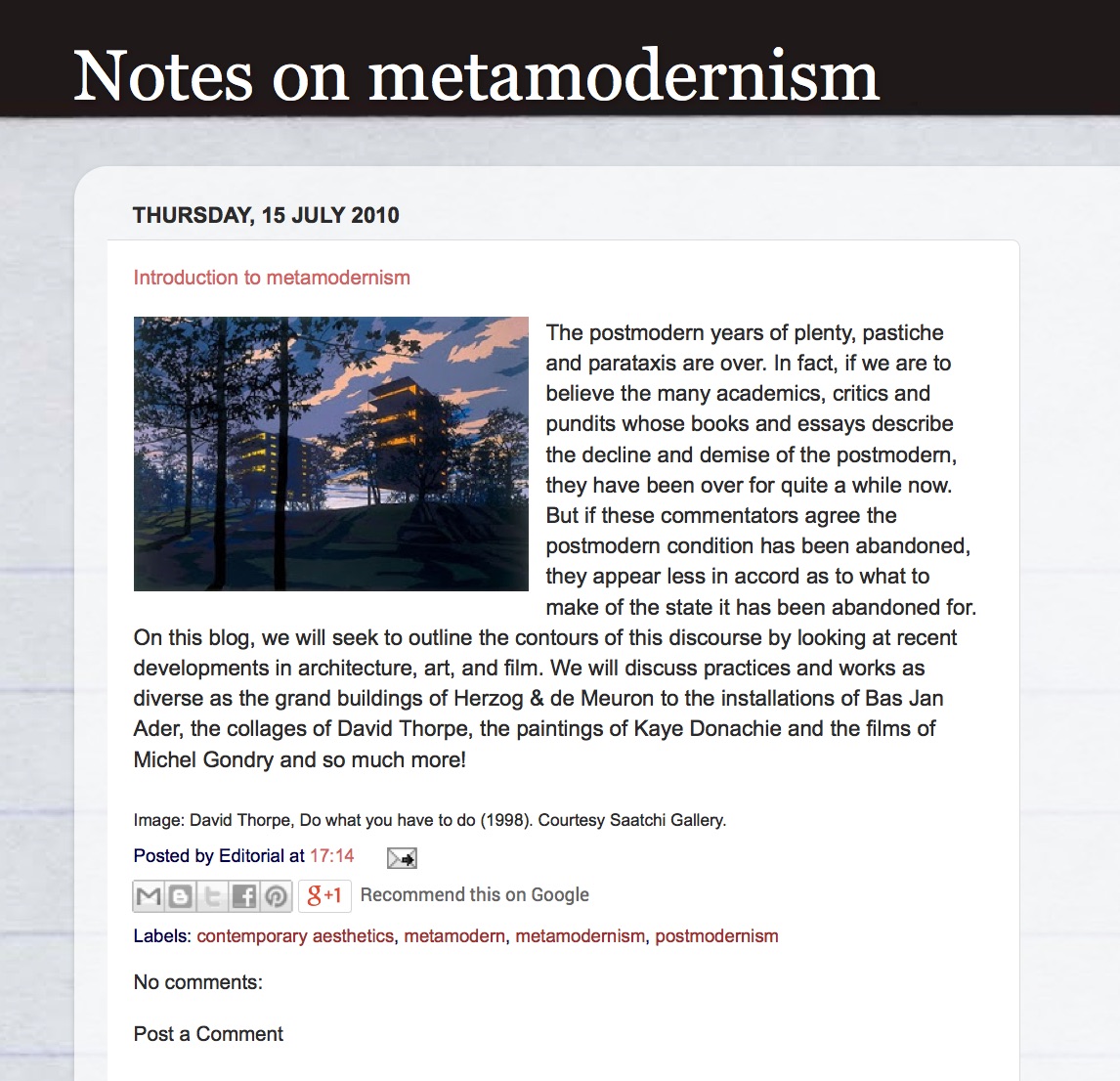
To be more specific though, Van den Akker set up a simple ‘research blog’ on Blogspot on 15 July 2010, and tweeted a link to it the following day.

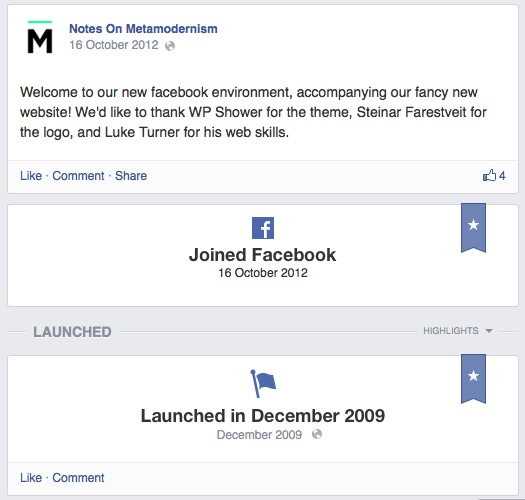
The following week, a @metamodernism Twitter account was set up, which began by tweeting a link to the blog, before the journal article, re-constituting posts from the blog, was published online in September. In November, the site moved to the slicker ‘metamodernism.com’ and a Facebook page was set up – though it too was replaced, then edited retroactively as if ‘launched in December 2009’:
An initial Wikipedia page for ‘metamodernism’, mostly summarising the ‘critically acclaimed article,’ was created in February 2011, by the unverified user ‘Fredrik holmsted’. The following week, after ‘holmsted’ saved his first 35 edits to the page, Van den Akker made edits under his own name on a section of the ‘Post-postmodernism’ page regarding metamodernism and his and Vermuelen’s contributions to the field, then argued with another user who had removed ‘Fredrik’s’ edits the day before, apparently commenting as both ‘Fredrik’, then himself, and agreeing heartily with how the former ‘quite rightly’ celebrates his and Vermuelen’s work. (For what it’s worth, here’s another user taking issue with the article’s claim that Vermuelen and Van den Akker coined the term ‘metamodernism’.)
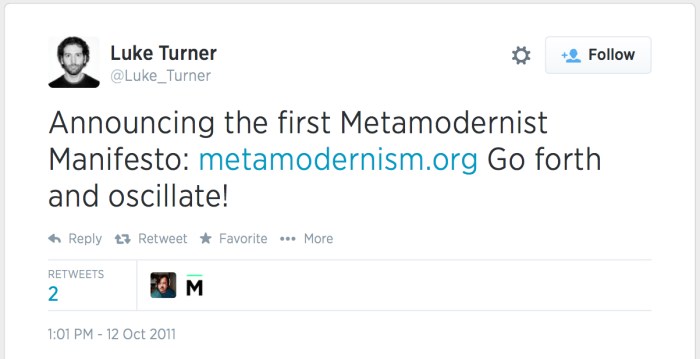
All of this succeeded in building a critical buzz around metamodernism, leading to fairly wide press coverage and large-scale exhibitions over the following year. London-based artist, Luke Turner, the only non-academic member of the site’s editorial board, then helped bring that discourse into more practical contexts with his Metamodernist Manifesto, posted at ‘metamodernism.org’ in October 2011 – again, announced by his first tweet:
(Here’s a link to the first version of the Modernist Manifesto posted, compliments of the Wayback Machine internet archive.)
Turner’s manifesto echoes the distinctions between modernism’s ‘naivety’ and postmodernism’s ‘cynical insincerity’, from which ‘We must liberate ourselves…’ (No. 2) Again, all of this seems wonderfully analogous to the sort of media and marketing savvy that critics like Catherine Turner, Michael North, or Kevin Dettmar have traced so fruitfully among the old modernists.
LaBeouf
If metamodernism came to your attention only recently, it might have been since January 2014, when the actor Shia LaBeouf responded to accusations of plagiarism with a series of public ‘performance’ pieces. These included an extended Twitter apology and interview via email on Bleeding Cool news, both of which were also plagiarised. At some point in early January, LaBeouf began collaborating with Luke Turner, which led to the reposting of the 2011 ‘Metamodernist Manifesto’ – now ‘by Shia LaBeouf’ – on January 12th. The following day, he began tweeting the phrase ‘I AM NOT FAMOUS ANYMORE’ once a day until February 9th, when he showed up at the Berlin Film Festival with it written on the paper bag he wore over his head.

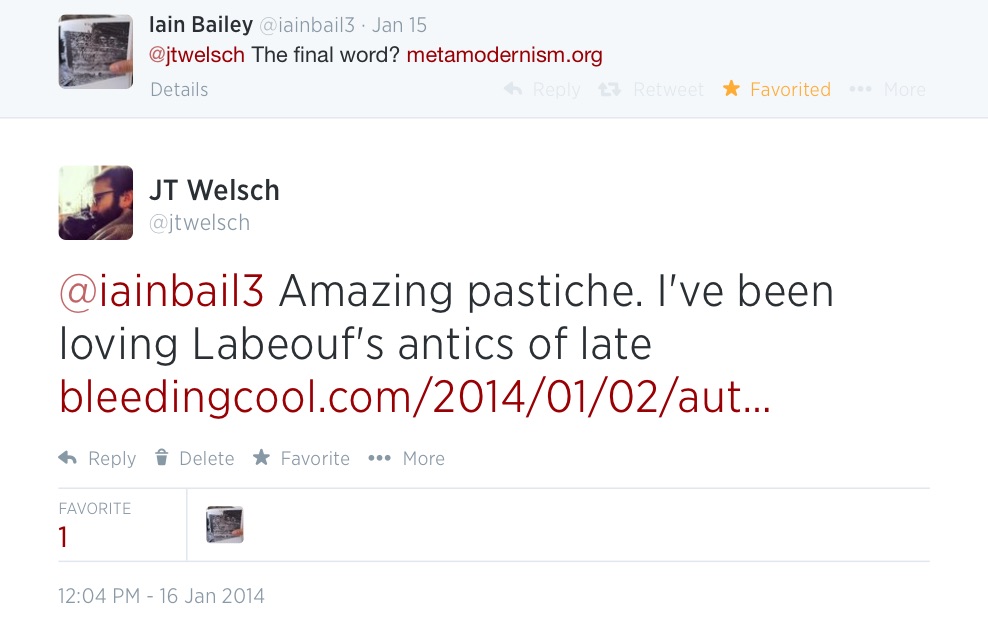
The re-attributed manifesto was brought to my attention by a friend who had heard me mention metamodernism, to which I replied, with a link to the Bleeding Cool interview:
Imagine my surprise (and paranoia) when, less than ten minutes later, I received an email from Mr LaBeouf himself:
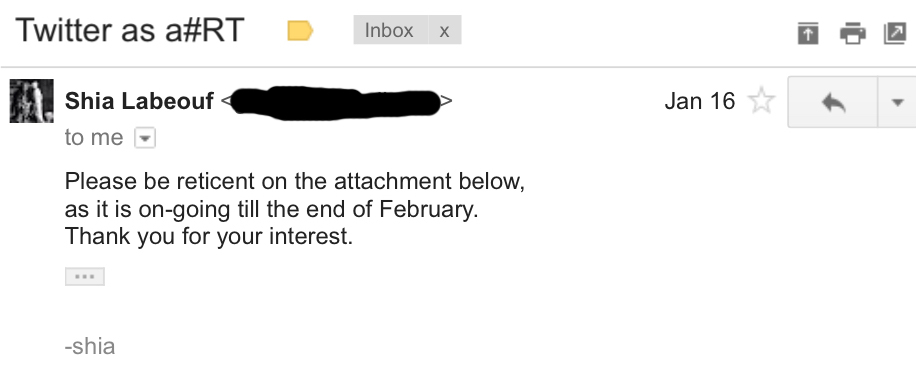
The attached manifesto, ‘TWITTER AS ART’, explained that his twitter account was now ‘meta-modernist performance art. A Performative redress which is all a public apology really is.’ It also acknowledged Turner and conceptual poet Kenneth Goldsmith as collaborators. I’ll leave you to Google this partnership’s further and on-going activities.
I only mention their campaign because of the way Seth ‘First Responder’ Abramson inserted himself into the conversation, first with an essay for Indiewire, explaining the metamodernist context for LaBeouf’s ‘intellectually provocative’ actions – then, a couple of days later, a poem on the Huffington Post. Remixed entirely from the actor’s tweeted phrases over the previous month, it’s difficult not to read ‘The Public Apology of Shia LaBeouf’ as a rehearsal for ‘The Last Words for Elliot Rodger,’ published four months later. Where LaBeouf was accused of using metamodernism as a retroactive excuse for his red-handed act of plagiarism, we can at least credit Abramson with a pre-emptive investment. All the same, it was only in July 2013 that he first used the term and announced his alligance in a pair of Huffington Post essays, ‘On Literary Metamodernism’ (20 July) and ‘Ten Things You Need to Know About Metamodernism’ (22 July). ‘Of late,’ he writes in the first piece, ‘I and some others have begun using the term “metamodernism” to circumscribe both our own poetry and much of the innovative poetry and poetics we see emanating from the Gen-M poets.’ (Gen-M = ‘MFA Generation’, in Abramson’s terms.) In the ‘Ten Things…’ piece, two days later, Abramson outlines a whiggish narrative in which, having read the ‘Modernists’ (‘T.S. Eliot, Ezra Pound, Marianne Moore’) in high school or college, then the postmodernists in ‘advanced’ or ‘graduate level’ English courses, he will now introduce us to metamodernism:
Metamodernism is a hell of a lot more fun than its predecessors; metamodernism is far better than either Modernism or postmodernism at synthesizing youth culture in contemporary America; and […] metamodernism is more likely than either Modernism or postmodernism to teach us, in real time, how to make our own lives more bearable (Huffington Post, 22 July 2013).
This begs two questions: Could that Elliot Rodger poem have at least made a tragedy ‘more bearable’, if not ‘synthesizing youth culture’ or being ‘a hell of a lot more fun’? And, would the groundwork Abramson had laid, by lately affiliating himself with metamodernism, be enough to absolve him? To the latter, at least, the answer is, decidedly, ‘no’. While the Huffington Post has not responded to the online protest or removed the poem, Omnidawn, publisher of the forthcoming Best American Experimental Writing anthology of which Abramson is co-editor, issued a statement condemning ‘actions’ which ‘are not in alignment with our principles’ (29 May). But perhaps the most damning (if not deeply hypocritical) judgment came from Luke Turner, who took to Twitter (where else?) the day after the poem was posted:
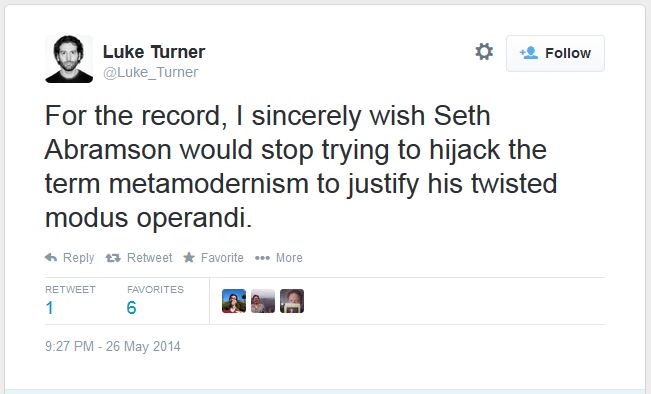
A second tweet explained, (by contradicting the ex-communication of the first):
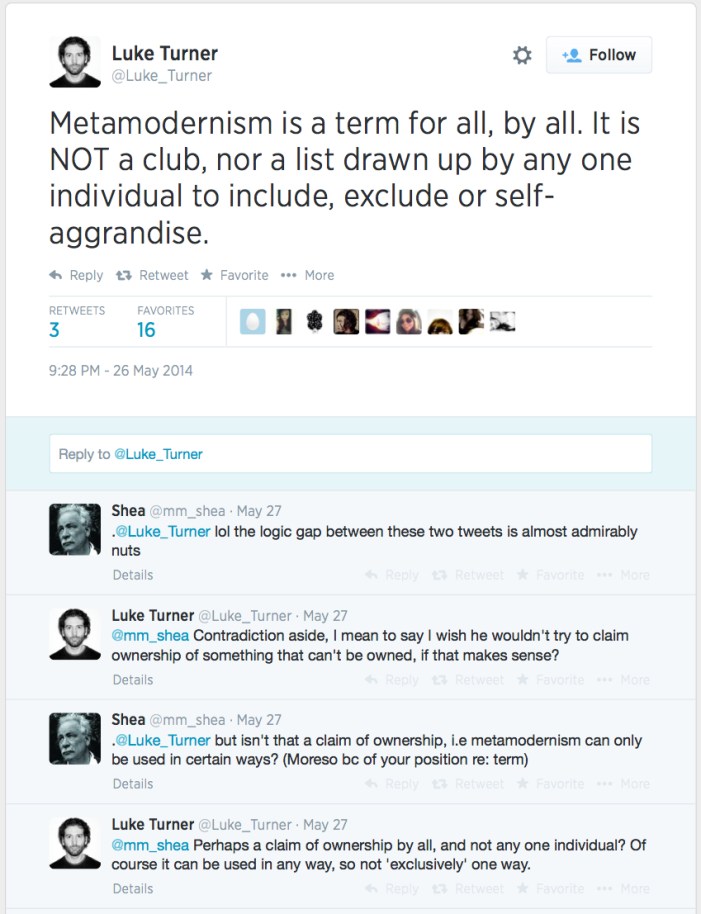
Again, for Huffington Post or Twitter, here read The Dial or back pages of The Little Review. For ‘hijacking metamodernism,’ read Amy Lowell and Imagism, Breton and Dadaism, etc.
Beer
Partly to avoid false-advertising, I’ll finish by looking briefly at a text that could be read as ‘metamodernist’ in a much more literal sense, but offers a striking contrast in the way it tempts, but then ultimately avoids such double-edged hoopla. Early in 2010, the online journal Quarterly Conversation posted this notice, among a more general news round-up:
Speaking of the young, I have no idea how young John Beer is, but good god, what chutzpah – hard to imagine in anyone who has not somehow managed to maintain the steely confidence of youth – is required to name your book The Waste Land and Other Poems! Impossible not to admire, no? (Levi Stahl, ‘A line is a proposition; a post is a jumble sale’, QC, 30 March 2010)
Not only did this mysterious, ageless John Beer have the ‘chutzpah’ to give his debut such a famous title, but Canarium Books, who published it that year, did a pretty good job of imitating the marbled cover of the 1923 Hogarth edition of Eliot’s book.
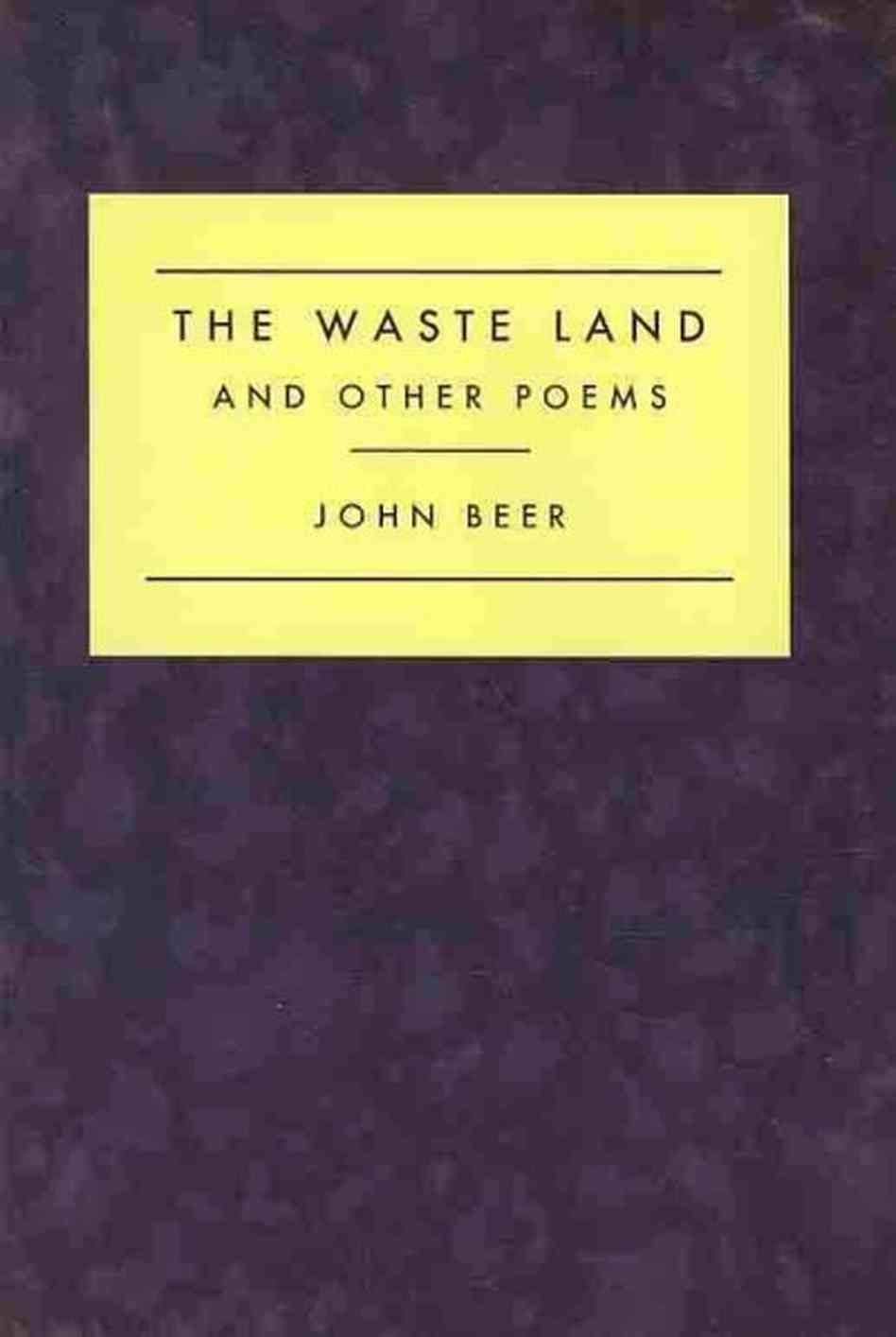
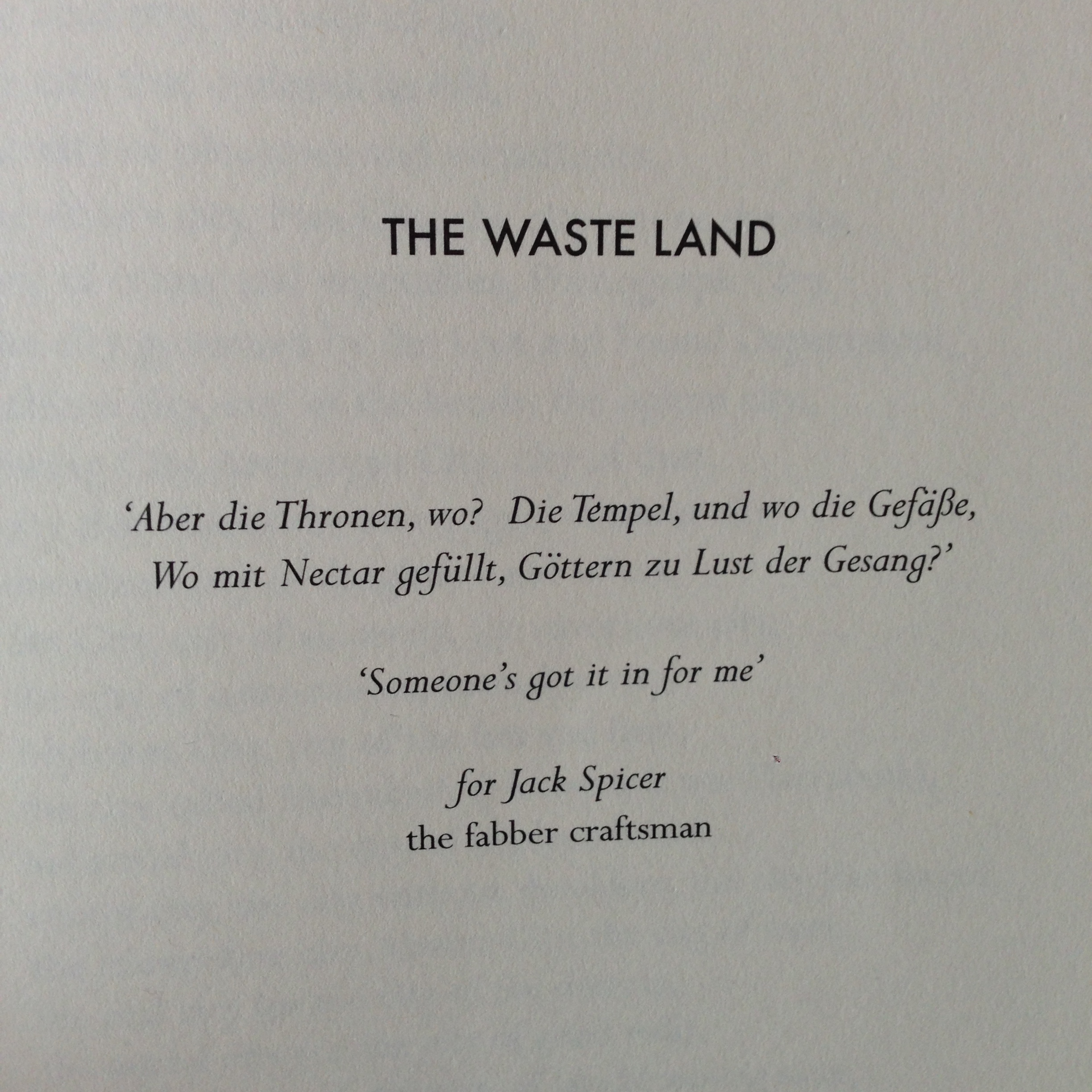
And yes, the book begins with a long, five-part poem, called The Waste Land, which ‘remixes’ much of the language and imitates the structure of Eliot’s poem, down to the dedication ‘for Jack Spicer, the fabber craftsman’ and extensive ‘Notes’:
All the makings of a LaBeoufian scandal, indeed. If you hadn’t heard of the book until now, you might be wondering how you missed the great fuss it surely caused, especially when the Poetry Society of America bestowed its prestigious Norma Farber First Book Award upon it. The sheer temerity begs us to ask, as of LaBeouf or Abramson, ‘Is this guy for real?’ Or, in the words of reviewer ‘Leah’ on Goodreads:
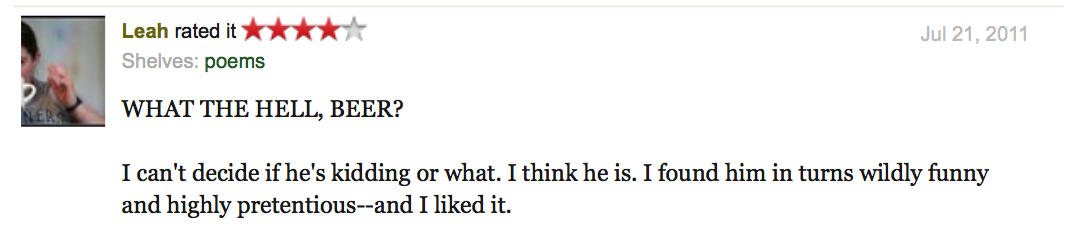
We might also assume Beer must be young, too young to know better, too young to care. John Beer was 41 when the book was published. I’m not saying that isn’t young, although he had already outlived Spicer and would have been barely ineligible for the Yale Younger Poets prize, if either of those are any measure. And I admit I’m only working out his age from a reference in the book to having been born in 1969, since there’s so little information available elsewhere. The tiny blurb in the back of the book says he lives in Chicago, although his Twitter account now says Portland.
Yes, Twitter – he can’t be entirely invisible then, can he? But find me another author on social networking who tweets so seldom, and has never once mentioned his own book. His first tweet, in January 2009, sums up that wariness: ‘I’m about to feed the social networking beast.’ (26 Jan 2009) – followed by 9 months of silence, and only one tweet in all of 2010, the year his book came out, to make a little joke about the Spiderman musical. If this is shameless self-promotion, as the kids say, you’re doing it wrong. Maybe Beer spent too long with poet-cum-hermit Robert Lax on a remote Greek island in the 90s to re-acclimate himself to the shrewdness necessary for the cutthroat world of contemporary poetry. Poet and professional blurbist, John Ashbery, had served up this one on a plate: ‘Only a genius could write a book called The Waste Land and Other Poems. Well, John Beer is that person.’ If only the publisher had thought to include this anywhere on the book itself! To give Beer his due, the book had what we might generously call a handful of reviews, although most of these were such level-headed, serious engagements with the text itself, and hardly seemed outraged at all. Again, if this is clickbait (also known as ‘impact’), they’re clearly doing it wrong. How can anyone expect to contribute to the revolution without a single Amazon review, let alone those written by friends and loved-ones?
I wish I had time for my own level-headed and serious engagement with the text itself, because it really is very good. Of course, I’d worry about too many people becoming fans of this totally obscure book you probably haven’t heard of. Again, the hipster’s metamodern double-bind is the same as the modernist’s: play the game or remain unknown. That, and that the delicate balance between sincere irony and ironic sincerity is still no laughing matter. Ultimately, says Stephen Burt, in a complimentary way, Beer’s ‘jokes and puzzles say that we have not progressed much since the deep ends of Eliot’s modernism, that we have yet to get past Eliot’s own bitter critique of our illusions, dated as that critique now seems’ (Boston Review, 1 Jan 2011). Maybe it’s this reticence towards progress that kept the book off the Metamodernists’ radar, or vice versa.
 J.T. Welsch